Last reviewed: October 2026. Rules described here apply in England; Wales, Scotland and Northern Ireland have their own building regulations.
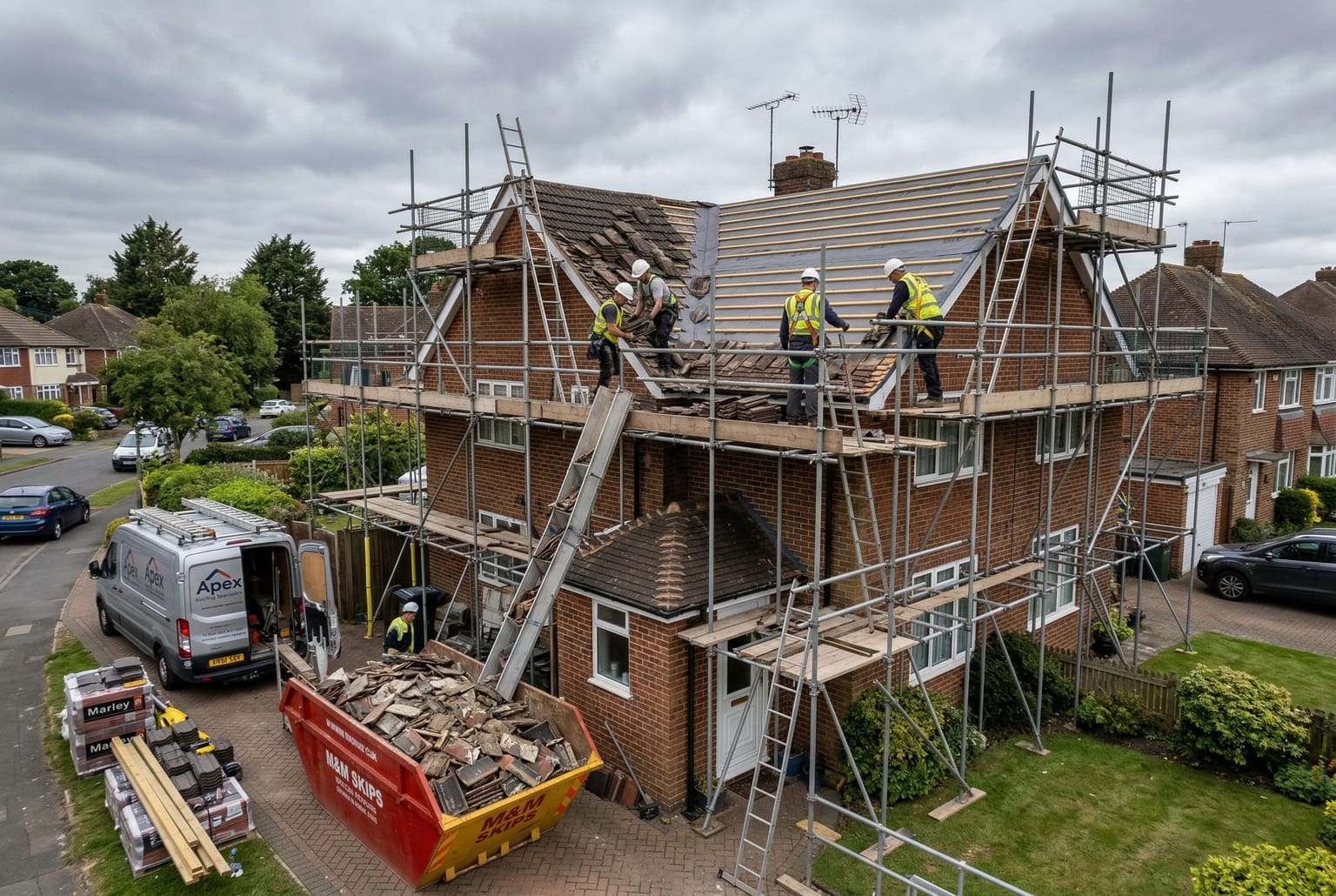
If you are replacing your roof covering, plan to upgrade the loft insulation in the same job: in England a full re-roof normally counts as renovating a "thermal element", and the building regulations then expect the roof's insulation to be brought up to a set standard where that is practical and cost-effective. Doing it while the scaffolding is up and the loft is already disturbed is also usually the cheapest and least disruptive time to do it.
This guide explains what the rules say, what the work typically involves, and what to ask the roofers who quote for your job.
Why does re-roofing affect your insulation at all?
The Planning Portal's guidance on re-roofing says that in most situations replacing the roof on an existing building will need Building Regulations approval, and that "as a roof is defined as a thermal element, the work to re-cover a roof should also include for improving the thermal insulation properties of the roof."
In plain terms: a roof is one of the parts of your home that keeps heat in, so when you renew most of it, the regulations treat it as a chance to make it perform better rather than putting it back as it was.
When do the rules kick in?
Approved Document L, Volume 1, the official guidance on energy efficiency in homes in England, says the whole of a thermal element should be upgraded when either:
- more than 50% of the surface of that element (here, the roof) is renovated, or
- the work is a "major renovation", meaning more than 25% of the surface area of the building's whole external envelope is renovated.
Patching a few slipped tiles or repairing a leak does not reach those thresholds. Stripping and re-covering the whole roof usually does. Our guide to new roof costs covers the same thresholds and the option of using a roofer who can self-certify the work through a competent person scheme.
What standard does the roof need to reach?
Approved Document L gives a target U-value (a measure of how much heat passes through) of 0.16 W/m²K for a pitched roof when the roof covering is renewed and there is no living space in the loft. Its examples of how to get there are:
- If the existing loft insulation is less than 50mm, in poor condition, or will be disturbed by the work: provide loft insulation of about 250mm of mineral fibre or cellulose fibre, laid between and across the ceiling joists, or loose fill or an equivalent.
- If the existing insulation is in good condition, between 50mm and 100mm thick, and won't be disturbed: top it up to at least 250mm.
The document also allows for real-world limits. If reaching 0.16 is not technically or functionally possible, or would not pay for itself within 15 years, the roof should be upgraded to the best standard that is practical and does pay back within 15 years. Where the loft is already boarded and the boards are staying, it says the practicality of the insulation work needs to be considered.
For a room in the roof (a loft conversion), the same target applies but the insulation goes at rafter level instead, which is a more involved job.
Why do it at the same time as the roof?
Even where the regulations don't strictly require it, combining the two jobs makes sense:
- Access is already there. The roofers are working on the roof structure and often going in and out of the loft anyway.
- The loft is already disturbed. Old insulation is often trodden down, dirty or moved during re-roofing. Approved Document L treats insulation "likely to be significantly disturbed or removed" as a reason to provide new insulation, not just a top-up.
- One set of checks. Building control or the roofer's competent person scheme will be looking at the work anyway, so the insulation can be checked as part of the same job.
The Energy Saving Trust puts the lifespan of correctly installed loft insulation at around 40 years, so it is worth getting right while the roof is open.
How much does it cost, and what could you save?
The Energy Saving Trust's figures (last updated May 2026) for a typical professional installation in Great Britain are:
| Job | Typical installation cost (GB) |
|---|---|
| 270mm of loft insulation, from none | £750 |
| 270mm of loft insulation, topping up from 120mm | £600 |
It estimates that topping up from around 120mm to 270mm could save around £17 a year on energy bills in Great Britain (£20 in Northern Ireland). A loft that starts with little or no insulation loses more heat, so the saving there is bigger. These are unsubsidised averages; a roofer or insulation installer will price your own loft.
For the different types of loft insulation, from mineral wool rolls to rigid boards, see Better Lofts' guide to loft insulation options.
Can you get help paying for it?
Possibly, depending on your income and where you live. In England, the government's Warm Homes: Local Grant can pay for improvements including loft insulation for privately owned homes with an Energy Performance Certificate (EPC) of D to G, usually where household income is £36,000 a year or less, or in certain postcode areas or benefit situations. Your local council runs the survey and organises the work.
The older schemes are closing: the government confirmed that the Great British Insulation Scheme ended on 31 March 2026 and that ECO4 ends on 31 December 2026 (GOV.UK response, January 2026).
A grant-funded installer will not normally be the same company as your roofer, so check timings before you book the roof. To see whether you might qualify for help with loft insulation, UK Energy Partnership has a separate guide.
What about ventilation and condensation?
This is the part most likely to go wrong. The Energy Saving Trust warns that insulation makes the loft colder, which makes condensation more likely, and that you should not cover vents, grilles or airbricks. If you already have damp in the loft, it advises fixing the cause before adding insulation.
Approved Document L's examples for re-roofing all say the same thing: assess the condensation risk in the roof space and make provision under Part C of the Building Regulations, which deals with moisture. In practice, ask your roofer:
- Which underlay they plan to use, and whether it is breathable.
- How the roof space will be ventilated, for example eaves or ridge vents.
- How they will keep insulation from blocking the airflow at the eaves.
If you plan to board the loft for storage afterwards, the Energy Saving Trust notes that thick insulation can make boarding difficult and that mineral wool should not be squashed. Raised loft boarding is one way round it; see Better Lofts on loft boarding.
Questions to ask when you get roofing quotes
- Will this job need building control approval, or will you self-certify it through a competent person scheme?
- Does your price include bringing the loft insulation up to the standard in Approved Document L? If not, who will do it?
- What will happen to the existing insulation while the roof is stripped?
- How will the roof be ventilated once the extra insulation is in?
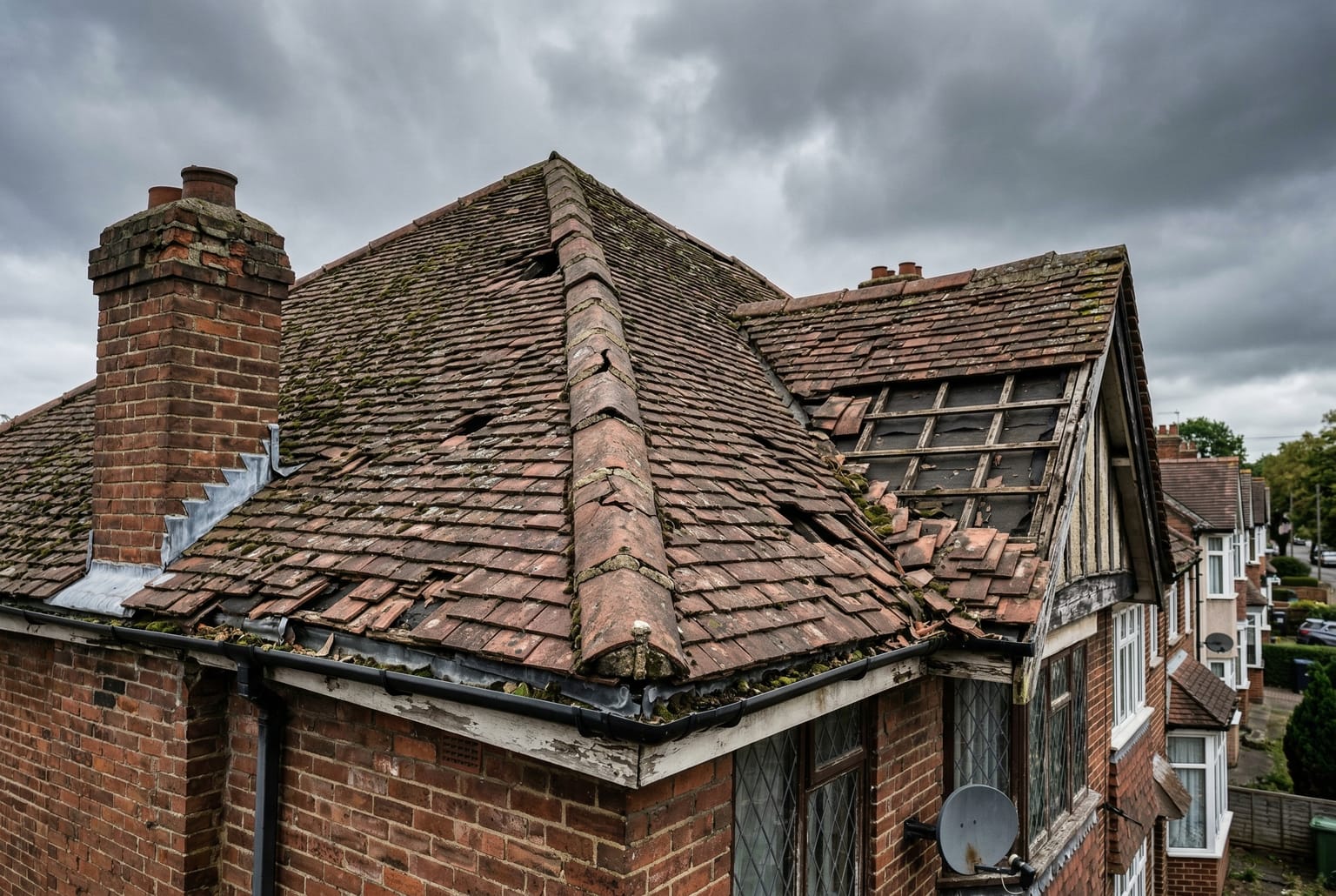
If you are not yet sure whether you need a new roof or a repair, start with our warning signs that a roof needs replacing.
Frequently asked questions
Do I have to upgrade my loft insulation when I replace my roof? In England, if you renovate more than 50% of the roof, Approved Document L expects the roof's insulation to be upgraded to a target U-value of 0.16 W/m²K where that is technically feasible and pays back within 15 years. Small repairs don't trigger it.
How thick should loft insulation be? Approved Document L's re-roofing examples use about 250mm of mineral fibre or cellulose fibre. The Energy Saving Trust says current building regulations recommend a minimum of 270mm for mineral wool; other materials need different depths.
Can my roofer fit the insulation? Some do, and some will bring in an insulation installer. Ask each roofer whether insulation is included in their quote so you are comparing like with like.
Will extra insulation cause condensation in my loft? It can if ventilation is blocked or reduced. Ask how the roof space will be ventilated, and fix any existing damp first.
Planning a new roof?
Better Roofing doesn't fit roofs or insulation itself. Get free quotes from local roofers — tell us about the job, mention that you want the loft insulation upgraded too, and we'll find up to 3 local roofers who cover your area and ask them to contact you with a quote. It's free and there's no obligation. You can also read more about new roofs and the materials available.